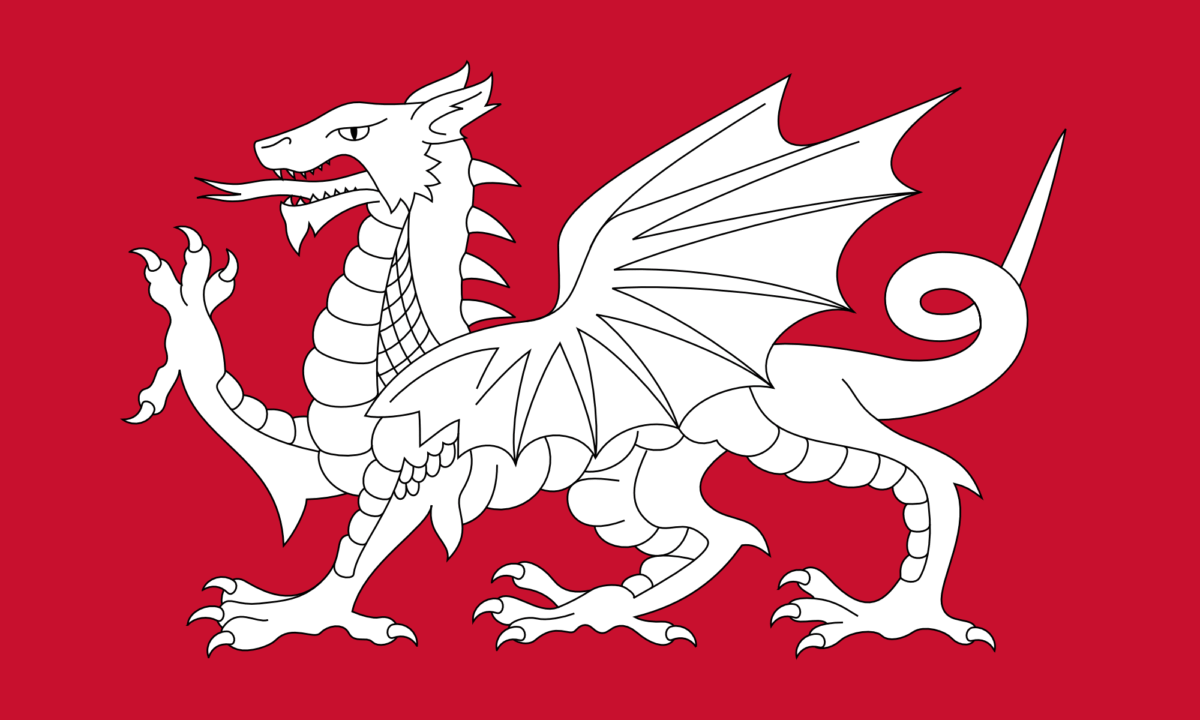
A Flag of the English – The White Dragon Flag

I have always been tremendously jealous of the Welsh flag. It’s got a dragon on it – it looks fantastic.

The English flag, by comparison, is rather plain – a red cross on white. Plainness is generally quite a good thing in flag design – it means the flag is easily recognisable and easily reproducible. But still – who doesn’t want a dragon? Dragon flags look fantastic. The flag of Bhutan has a dragon on it, and it looks amazing. The flag of the Qing dynasty also had a dragon on it, and that looks even better – a truly outstanding flag design – much better than the current Chinese flag – they should consider going back to it.

Why can’t we have a dragon on our flag? Well the thing is … we could. The symbolism of the red dragon on the Welsh flag goes back to Arthurian legend. A red dragon and a white dragon are locked in combat, with the red dragon representing the native Britons (the Celts) – now the Welsh – and the white dragon representing the Anglo-Saxons – now the English. So a white dragon is a symbol of the English.

This is fairly well known – lots of people already know this, and lots of people have already had the idea of making a white dragon flag to represent the English. (I mean, you could argue the idea never went away from Anglo-Saxon times – the Kingdom of Wessex used a golden dragon as its symbol (still on the flag of Wessex today, though as a wyvern (the distinction being somewhat unimportant here)), and the flag of Somerset also features a dragon.) But the idea has not spread very far – partly I think just because of a lack of awareness of the symbol, but also because of a lack of good designs. A good design propagates on its own.

So for a while now I’ve thought it would be good to make some designs for an English White Dragon flag – an unofficial flag as an alternative to the St. George’s Cross.

The simplest thing to do is just to change the colours on the Welsh flag, as shown below. (I am most certainly not the first person to do this – you can see that others have already done it just with a quick internet search.)
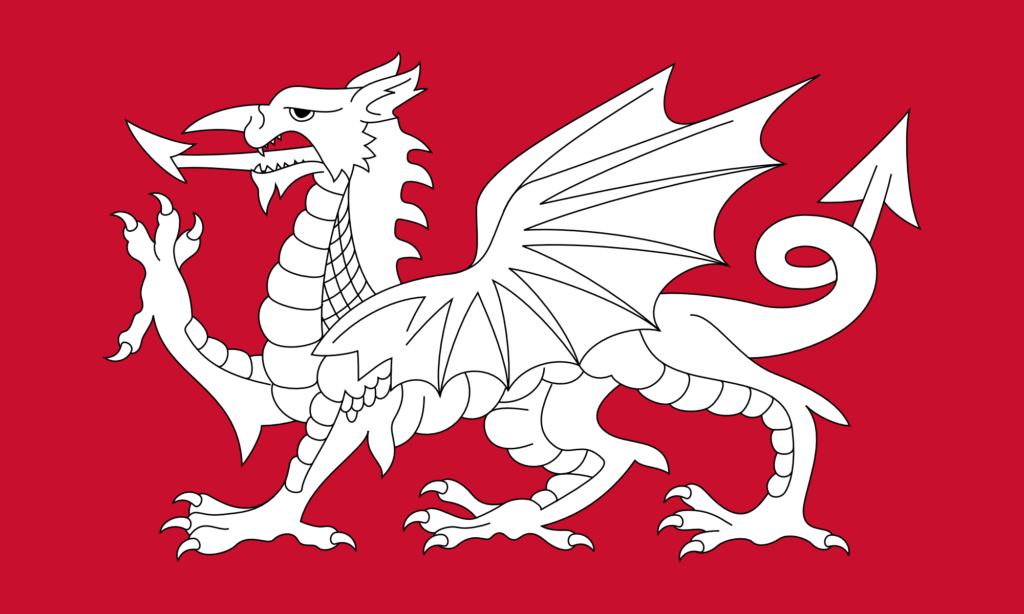
This is the exact same design as the Welsh flag – it just uses the red of the dragon from the Welsh flag as the background, and then the dragon itself is pure white. The design is incredibly striking – I think actually even more so than the Welsh flag.

This design also looks fantastic with a black background.

As with my design for a flag of Wiltshire (featuring a white horse), I find myself torn between different styles of illustration. The dragon on the Welsh flag is obviously very stylised – it’s not just a dragon, it’s a heraldic dragon. I particularly like heraldry and I quite like the heraldic style of illustration, but I do think there are some things that are a bit odd about the design here.

I have never liked what I call the ‘demon’s tail’ style of tail that the design above has. Almost every cartoon drawing of a demon has a tail like that. Personally I think it would look better if it were more naturalistic. That goes for the dragon’s tongue too.

I have also never liked the ‘nose horn’ of the dragon. This seems like a rather odd place to have a horn (that is, a forward-pointing one). In more naturalistic depictions of dragons – which are rather common nowadays thanks to CGI – you never see this. (It’s a remarkable thing that, with decades of stories and movies about dragons, we now have a very strong collective understanding of what a dragon is supposed to look like.)

So I set about modifying the above design. The result is below.
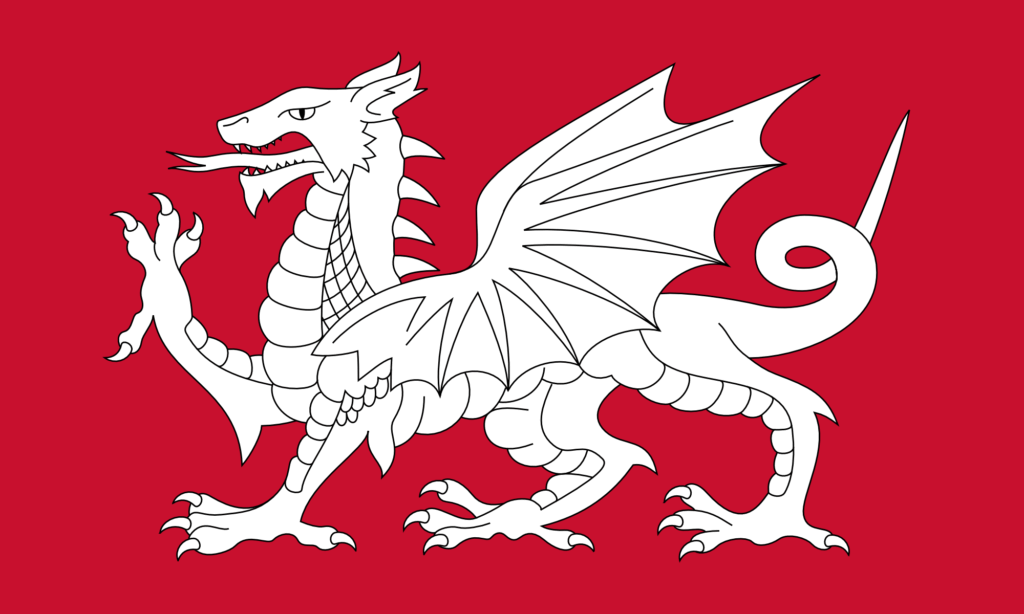
As with my design for a white horse flag for Wiltshire, I found that there were so many things to agonise over while making this design.

I wanted to make some improvements to the design, but I also wanted to retain much of the style – the heraldic style – of the original design. Of course, here we’re not dealing with a purely mathematical design – we’re dealing with freeform paths that can be given any shape. Should this control point go here? Should I move it slightly? Is that a better curve? That looks good, but does it deviate from the style too much? I agonised for hours and hours over it. I am not really certain about most of it, but at some point you just have to decide that it’s done.

I have removed the ‘demon’s tail’. I have also changed the tongue. Now, I’ve given it a forked tongue – that’s sort of a bit of a problem because of course a forked tongue typically carries the symbolism of the snake and of deception. That’s not the intended meaning here, of course – the aim is just to be naturalistic.

I have removed the nose horn, and elongated the dragon’s face. I think this is a tremendous improvement – again, more naturalistic – but of course it does lose some of that heraldic style. I have changed the eye quite substantially – making it a bit meaner. The eye on the original design makes the dragon look a bit dopey. I have also adjusted its spines – and I think this is the only change that I’m completely sure of.

There are so many other things I could have changed (adding more spines along the tail, changing the wings to be a bit more anatomical, changing the ears to look a bit more reptilian, and so on), but of course that risks losing some of the style. As with my white horse flag for Wiltshire, I consider this to just be Version 1 – I may make other versions in future with more modifications. I would also like to make some versions that don’t use the heraldic design at all – and which use something a bit more ‘modern’, for lack of a better word.

So we English can have a dragon on our flag, and it looks rather good. As ever, I don’t suggest making this the official flag – it’s just nice to have as an unofficial one. I’ll be getting some of these made for myself.

Somehow both boring and chaotic at the same time, 3/10 – Doctor Who – Wild Blue Yonder – Review

Well that was all over the place.

Let’s start with the first scene – a truly bizarre scene that becomes even more bizarre when you realise it had nothing to do with the rest of the story.

It’s 1666, and we see a man exiting an old house. He chats to a woman briefly, in a cheery English fashion, and then goes and sits under an apple tree, scrawling something in a notebook. One of the apples falls on his head, and he has an idea.

It’s Sir Isaac Newton. But for reasons entirely baffling, Sir Isaac Newton is played by half-Indian actor Nathaniel Curtis.

*Sigh*

Now, these episodes of Doctor Who cannot escape the context in which they are being released. As I said in my last review, Doctor Who has had three disastrous series’ led by Chris Chibnall. It needs to show, now, that it is going to change course. It needs to show, now, that it is not going to make the same mistakes. If it doesn’t, it will be well and truly dead. 

One of the major errors of the show during the Chibnall Era (which I think henceforth I will refer to simply as ‘The Mistake’), was its relentless pandering to Twitter misosophy. Every bad idea that received applause from the seals of Twitter was rammed into the show. It is a virus that infected Star Wars, Star Trek, Amazon’s “Wrongs of Prime”, as well as Doctor Who. Doctor Who needed to show that the fever had passed – that it was not going to pander to these anti-sci-fi, anti-logic idiots anymore.

One of the symptoms of this virus is the idea of changing the ethnicity of established characters or (worse) historical figures – always from “white” (a word that is only valid in a North American context), or native British or native European, to black (another word that is only really valid in a North American context), south Asian, or arabic. (For some reason, none of the other ethnic groups in the world get a share.)

I say again here that these episodes cannot escape the wider context. The ethnicity of the actor not matching the ethnicity of the character is not always a bad thing. The show Merlin – on the BBC about 15 years ago now – a fantastic show – had Lady Guinevere played by Angel Coulby. No-one cared. But that was for two reasons. Firstly, the show established very early on that it was a ‘modernised’ telling of Arthurian Legend. There were loads of changes to modernise it – including making all of the characters young. And it remained consistent with this modernisation throughout. But secondly, that show was not being made in a time when rabid ideologues online were trying to make every historical figure black and ‘decolonise’ every book and fact in sight. Viewers trusted that there was no vicious ideology behind the change – it was just creative licence.

Nowadays, though, all of the great science fiction and fantasy film and television series’ have fallen into the hands of a horde of Hollywood lobotomites intent on destroying them (and succeeding). When characters and historical figures have their ethnicities changed nowadays, it is ALWAYS because of that ideology. So you must avoid it if you want to demonstrate that you are no longer deferent to that ideology.

This episode has not avoided it. In fact it’s put it front and centre, right at the start of the episode. This therefore shows complete adherence to this stupid, stupid, stupid ideology. It shows an orgasmic obsession with promoting The Message. This does not bode well for Doctor Who.

Any whole-brained person already knows why this case of ethnicity-swapping is bad, but for the slow people at the back, I’ll explain in more detail. Russell here is showing that he is completely on-board with this distinctly American ideology. It is an ideology that asserts that all Americans of European descent, as well as all native Britons and Europeans (who it erroneously labels ‘white’) are intrinsically bad, and that all culture and history must be edited to reduce their presence or remove them entirely. It’s an epitomisingly racist ideology. These ideologues go giddy when they see ‘white’ characters and historical figures changed to be ‘non-white’, but they would be apoplectic if it happened the other way round. (If we saw Martin Luther King played by Benedict Cumberbatch, or Nelson Mandela played by Eddie Redmayne, or Srinivasa Ramanujan (the great Indian mathematician) played by Daniel Day-Lewis, these ideologues would make it their life’s mission to exact revenge on everyone involved.)

Russell is showing that he doesn’t care about immersion. (Seeing a figure like Sir Isaac Newton played by someone who doesn’t look like Sir Isaac Newton pulls you out of the story (unless there’s an in-universe reason for it).) Any show about time travel has a great opportunity to explore history – Russell here is showing that he doesn’t care about any of that. History exists simply to support The Message. That is all that matters – The Message.

So instead of this being a fun opening to the episode, it just becomes two minutes of Russell desperately trying to appease American sociology professors.

The TARDIS crashes into the very tree that not-Newton was sitting under – how that weedy little tree was holding up the TARDIS I don’t know. The Doctor and Donna emerge, work out who the man isn’t, and make a joke about gravity. This, apparently, is the first time this random man has heard the word ‘gravity’. (Entirely ludicrous – the word ‘gravity’ was known about for centuries before this – but fine, it’s Doctor Who, whatever.) This random man is unable to recall the word just said to him, however, and accidentally remembers it as ‘mavity’. 

And that’s it – the scene ends. That was the first two minutes, and there was already that much wrong with it.

What’s worse, nothing in the rest of the episode had anything to do with it – well, with the exception of ‘mavity’. Later in the episode the Doctor and Donna sometimes say ‘mavity’ instead of ‘gravity’, suggesting that their short excursion to the past has altered history, and now everyone says ‘mavity’ (except the Doctor, sometimes). This is probably all setup for something later – which if it is, great. It does still make for a rather disjointed episode.

Now let’s get on to the actual story of this episode.

A lot of this episode was very slow. The first half of it after that opening scene was very slow. The characters talked much more than normal – with lines that added nothing. There were a lot of lingering CGI shots. Very few events happened, and the story did not set up a mystery or suspense well. In fact, the first part of the episode was so slow that by about half or two-thirds of the way through I started looking to see how long was left – that’s never a good sign.

This kind of problem is quite common in a lot of the Marvel and Star Wars shows on Disney Plus. Lingering shots – shots that are just too long or superfluous – and characters not getting anywhere – just kind of wandering around talking about irrelevant things. It’s very odd – and completely opposite to Davies’ normal style. Davies is normally excellent at using montages and music to increase the pacing, but here he has abandoned that. 

The pace of the episode does increase later. This episode did not need to be as long as it was – a lot could have been cut out – ten to twenty minutes of it, I think. It seemed like the script had been rushed – like it should have gone through several more rounds of edits to trim the fat.

At one point they refer to a thing called ‘the flux’ – I don’t know what that is and I don’t care to look it up – is that something they did during The Mistake? Don’t reference things from The Mistake, Russell, the returning fans neither know nor care about them. Treat The Mistake as though it didn’t happen. 

The basic idea of the story was okay: go somewhere where there supposedly aren’t any life forms, but actually there are. It’s been done many times. The whole which one of you is the real one has been done many times too – it was even parodied in Family Guy years ago. They’re not bad ideas – they’ve just been done a lot. 

The story did have a key flaw though. The Doctor suggests that the TARDIS brought them there deliberately to solve a problem (as it often does throughout the show – it takes them where they need to be). But had the TARDIS not appeared there at all, the problem would have solved itself. The ship would have blown up even if the Doctor and Donna hadn’t been there, killing the two aliens. The TARDIS didn’t need to appear there – and would have known this, given what we know about how the sentient TARDIS perceives time. This really is a script error – they just shouldn’t have had the Doctor suggest the TARDIS brought them there deliberately.

And then the episode ended with a glorious appearance from Bernard Cribbins. His character on the show remains incredibly popular – entirely because of Cribbins’ performance. It was a bizarre and sudden reversal of the tedium and nonsense of the rest of the episode. This episode would have been better if it had just been an hour of Cribbins and the Doctor chatting.

Unfortunately this moment was interrupted by explosions and stuff. We were also given the nightmare fuel of a plane falling from the sky and crashing nearby.

This episode was a mess. Before I started writing this review, I had a higher opinion of it. But this episode had ideological nonsense, slow pacing, lingering shots, boring dialogue, an overused core story idea, uninteresting set design and CGI, no memorable music, still a lacking vitality from the Doctor and Donna. The only properly good thing was Bernard Cribbins, and he wasn’t in it long enough. 

3/10