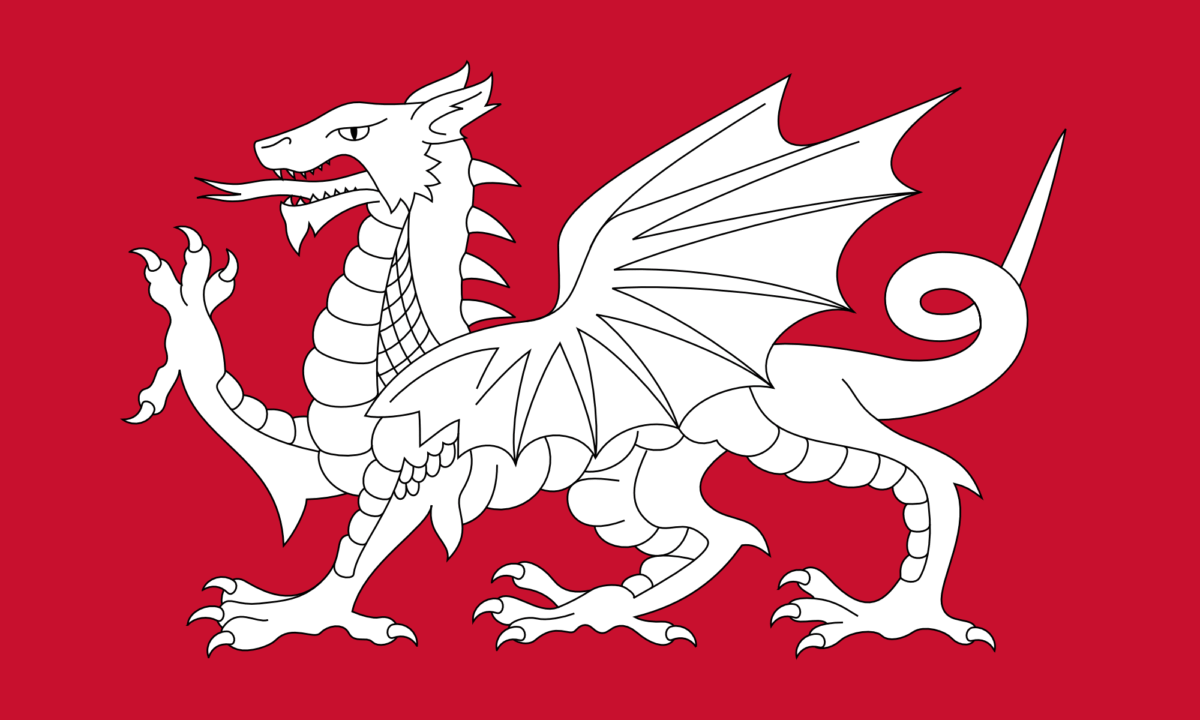
A Flag of the English – The White Dragon Flag

I have always been tremendously jealous of the Welsh flag. It’s got a dragon on it – it looks fantastic.

The English flag, by comparison, is rather plain – a red cross on white. Plainness is generally quite a good thing in flag design – it means the flag is easily recognisable and easily reproducible. But still – who doesn’t want a dragon? Dragon flags look fantastic. The flag of Bhutan has a dragon on it, and it looks amazing. The flag of the Qing dynasty also had a dragon on it, and that looks even better – a truly outstanding flag design – much better than the current Chinese flag – they should consider going back to it.

Why can’t we have a dragon on our flag? Well the thing is … we could. The symbolism of the red dragon on the Welsh flag goes back to Arthurian legend. A red dragon and a white dragon are locked in combat, with the red dragon representing the native Britons (the Celts) – now the Welsh – and the white dragon representing the Anglo-Saxons – now the English. So a white dragon is a symbol of the English.

This is fairly well known – lots of people already know this, and lots of people have already had the idea of making a white dragon flag to represent the English. (I mean, you could argue the idea never went away from Anglo-Saxon times – the Kingdom of Wessex used a golden dragon as its symbol (still on the flag of Wessex today, though as a wyvern (the distinction being somewhat unimportant here)), and the flag of Somerset also features a dragon.) But the idea has not spread very far – partly I think just because of a lack of awareness of the symbol, but also because of a lack of good designs. A good design propagates on its own.

So for a while now I’ve thought it would be good to make some designs for an English White Dragon flag – an unofficial flag as an alternative to the St. George’s Cross.

The simplest thing to do is just to change the colours on the Welsh flag, as shown below. (I am most certainly not the first person to do this – you can see that others have already done it just with a quick internet search.)
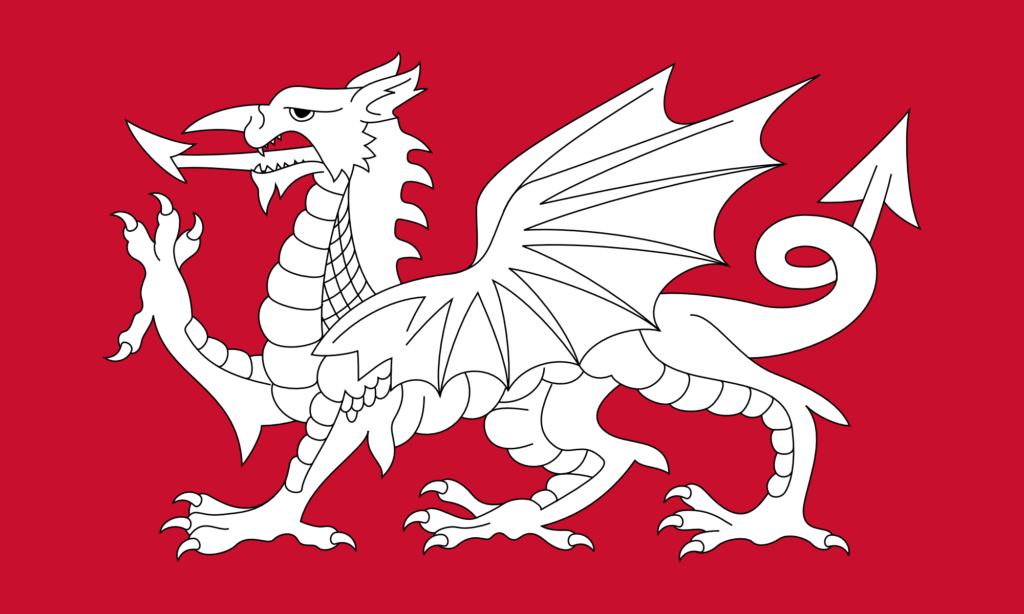
This is the exact same design as the Welsh flag – it just uses the red of the dragon from the Welsh flag as the background, and then the dragon itself is pure white. The design is incredibly striking – I think actually even more so than the Welsh flag.

This design also looks fantastic with a black background.

As with my design for a flag of Wiltshire (featuring a white horse), I find myself torn between different styles of illustration. The dragon on the Welsh flag is obviously very stylised – it’s not just a dragon, it’s a heraldic dragon. I particularly like heraldry and I quite like the heraldic style of illustration, but I do think there are some things that are a bit odd about the design here.

I have never liked what I call the ‘demon’s tail’ style of tail that the design above has. Almost every cartoon drawing of a demon has a tail like that. Personally I think it would look better if it were more naturalistic. That goes for the dragon’s tongue too.

I have also never liked the ‘nose horn’ of the dragon. This seems like a rather odd place to have a horn (that is, a forward-pointing one). In more naturalistic depictions of dragons – which are rather common nowadays thanks to CGI – you never see this. (It’s a remarkable thing that, with decades of stories and movies about dragons, we now have a very strong collective understanding of what a dragon is supposed to look like.)

So I set about modifying the above design. The result is below.
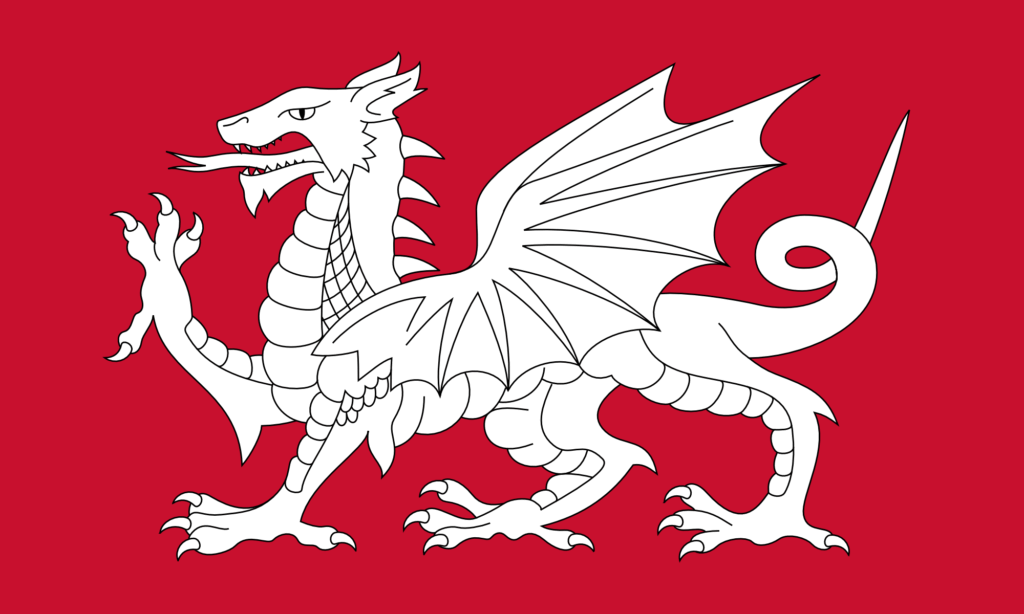
As with my design for a white horse flag for Wiltshire, I found that there were so many things to agonise over while making this design.

I wanted to make some improvements to the design, but I also wanted to retain much of the style – the heraldic style – of the original design. Of course, here we’re not dealing with a purely mathematical design – we’re dealing with freeform paths that can be given any shape. Should this control point go here? Should I move it slightly? Is that a better curve? That looks good, but does it deviate from the style too much? I agonised for hours and hours over it. I am not really certain about most of it, but at some point you just have to decide that it’s done.

I have removed the ‘demon’s tail’. I have also changed the tongue. Now, I’ve given it a forked tongue – that’s sort of a bit of a problem because of course a forked tongue typically carries the symbolism of the snake and of deception. That’s not the intended meaning here, of course – the aim is just to be naturalistic.

I have removed the nose horn, and elongated the dragon’s face. I think this is a tremendous improvement – again, more naturalistic – but of course it does lose some of that heraldic style. I have changed the eye quite substantially – making it a bit meaner. The eye on the original design makes the dragon look a bit dopey. I have also adjusted its spines – and I think this is the only change that I’m completely sure of.

There are so many other things I could have changed (adding more spines along the tail, changing the wings to be a bit more anatomical, changing the ears to look a bit more reptilian, and so on), but of course that risks losing some of the style. As with my white horse flag for Wiltshire, I consider this to just be Version 1 – I may make other versions in future with more modifications. I would also like to make some versions that don’t use the heraldic design at all – and which use something a bit more ‘modern’, for lack of a better word.

So we English can have a dragon on our flag, and it looks rather good. As ever, I don’t suggest making this the official flag – it’s just nice to have as an unofficial one. I’ll be getting some of these made for myself.
No, the comma does *not* always go before the closing quote mark – Logical Punctuation

‘The comma always goes before the closing quote mark.’

I’ve heard this a number of times over the last 7 years or so – mostly, but certainly not exclusively, from Americans.

And I had heard it in life before that too. I can’t remember exactly when I first heard it – I think it was possibly in secondary school, from one of my secondary school English teachers. But I do remember that when I first heard it, I immediately thought ‘That’s silly.’.

Consider the following sentence.

‘I think I like pears more than I like apples.’

Now let’s imagine that this is a line said by someone – a character in a novel, perhaps. Now, the ‘he said’ / ‘she said’ could be put at the end.

‘”I think I like pears more than I like apples.”, she said.’

Or we could split the sentence and put the ‘he said’ / ‘she said’ in the middle.

‘”I think”, she said, “I like pears more than I like apples.”‘

This illustrates the problem. That first comma in the line above – those who say ‘The comma always goes before the closing quote mark.’ would have it go before the first closing double quote mark – immediately after the word ‘think’.

But I think this is ridiculous. That comma is not part of the original sentence – what this person is actually saying. It is not part of the ‘inner sentence’ – it is part of the ‘outer sentence’. For clarity, I’ve written the same text again below, but coloured the ‘inner sentence’ green and the ‘outer sentence’ blue.

‘”I think, she said, I like pears more than I like apples.“‘

The double quote marks are the demarcations between the inner and outer sentences. You can join together all of the separately-quoted parts of the inner sentence to get back the original thing being quoted.

If we were to follow the ‘The comma always goes before the closing quote mark.’ rule, however, we would have:

‘”I think, she said, I like pears more than I like apples.“‘

This is clearly less elegant. The inner and outer sentence are now mixed together across the quote marks.

So I would say that the correct rule is: only that which is part of the quote goes within the quote marks.

Now sure, commas are for adding structure to written language – we do not speak them. (Well, they sort-of represent pauses in spoken language, but it’s not a hard-and-fast rule, and they’re better understood as making clauses easier to recognise in written text.) But that structure is still either of the inner sentence or the outer sentence, and putting a comma in the inner sentence when it’s actually part of the outer sentence can change the meaning.

I learned a while ago that my preferred style of using punctuation is called logical punctuation. And apparently the other style – the comma-before-the-quote-mark style – is known as typographer’s punctuation, or something like that. I’m not too sure about these names. ‘Logical punctuation’ is a bit grandiose, even if it is more logical, and I don’t know why typographers would be expected to be so slapdash in their approach to punctuation. But apparently these are terms that are used.

I’ve also seen it said that logical punctuation is the British style, and the other way is the American style. I’ve certainly heard Americans advocate for the comma-before-the-quote-marks style more often. I’ve heard Britons insist upon it too, though whether this is just because of the cultural backwash we get from America, I can’t say.

But regardless of what the best names for these styles are, and regardless of whether the Britons or the Americans use one style more, it is better to use logical punctuation.

The main argument I hear in favour of the American style is ‘It looks better.’. There’s just something about the lower punctuation mark followed by the higher one that looks better than the inverse. While aesthetics are very important in language, to some extent (only some) what you like is just what you get used to over time, and aesthetics should generally not be at the expense of function and semantics. (There are exceptions, of course, but generally.)

Some would say that my approach is perhaps the product of a mathematical mind. (I am a physicist by training.) You can certainly see the appeal of logical punctuation to a mathematical mind – logical punctuation perfectly mimics the way brackets work in mathematics. However, this is somewhere where the penetrating orderliness of mathematics should influence human language. Using logical punctuation allows you to avoid a great many problems that arise if you try to use the American style. The American style generally applies not just to commas, but to all punctuation. Consider the following sentence.

‘What did he say after “You’re not supposed to do that?”‘

The typographer’s style advocates for putting that question mark before the closing double quote mark, as I’ve written it above. But is the question mark part of the inner sentence or the outer sentence? Or both? You can’t tell – but it changes the meaning. If the question mark is part of the inner sentence, the person being quoted is asking a question. If it’s not part of the inner sentence, the person being quoted is making a statement.

This is clearly a problem, and if you try to follow the American style for an entire book, you will run into variations of this problem over and over again – with no way to be both consistent and always unambiguous. (You might think the problem won’t come up very often, but it does – it comes up A LOT.)

Logical punctuation solves this easily. If the inner sentence is a statement, you write:

‘What did he say after “You’re not supposed to do that.”?’

and if it’s a question, you write:

‘What did he say after “You’re not supposed to do that?”?’

Some people might find it visually clumsy to have all those punctuation marks bundled together like that. But again, the aesthetics you can adjust to if you just get used to it – but the semantic issues of the typographer’s style cannot be cleanly resolved.

I hope that logical punctuation becomes more popular. Britons seem to be split on it. But I think it’s an easy rule to remember: only that which is part of the quote goes in the quote marks.