A Flag of Wiltshire – A White Horse on a Green Field

I was born in Wiltshire, and I have lived in the county for the majority of my life. I have a very long ancestry here – I can trace my ancestry back over 400 years in just one town. (And it certainly goes back further than that – 400 years is just what I’ve been able to trace.) Various branches of the family tree spread out across the county.

There is, if you didn’t know, an official flag of Wiltshire. All (or at least most – I haven’t checked) of the English counties have flags. The Wiltshire one was designed in the 2000s by Mike Prior. I’m not overly enthusiastic about the design: curved green and white stripes, with a green circle in the middle and a golden great bustard (a bird native to Wiltshire) on top. (I like the great bustard, but I just don’t quite like the shapes in the rest of it.)

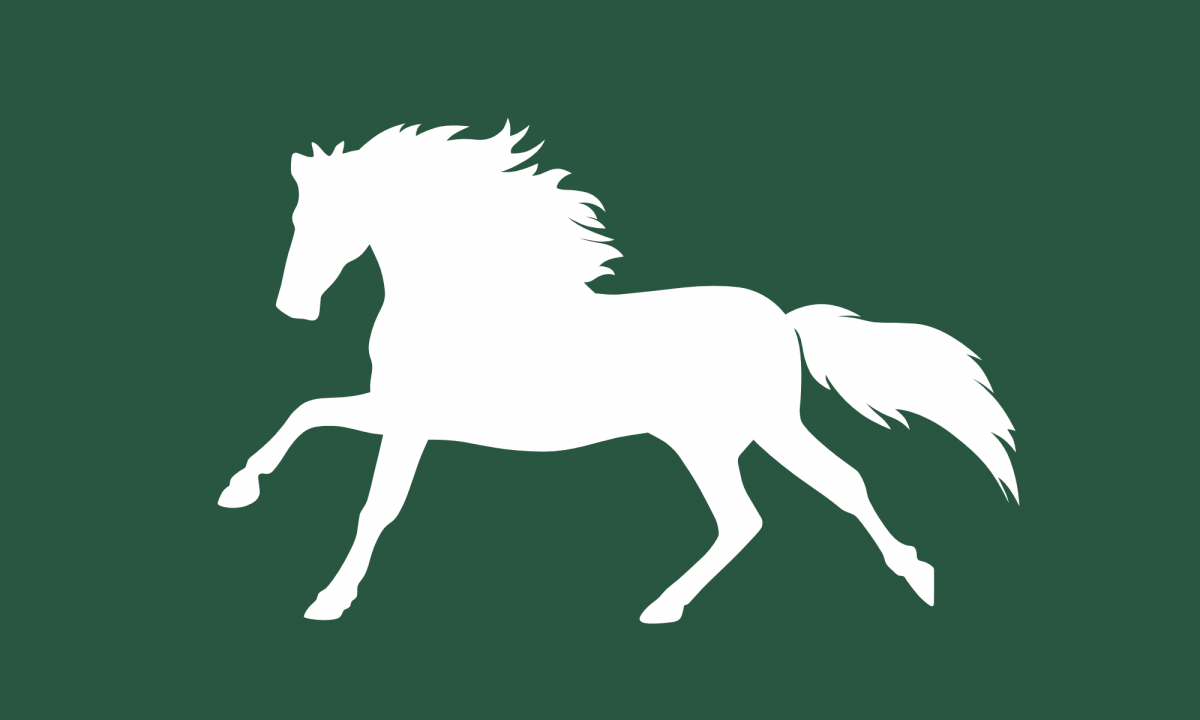
I’ve known for a while that there has been an alternate flag design – an unofficial one. It features a white horse on a field of green. It is a reference to the many white horse figures that can be seen on hillsides throughout the county – Wiltshire has the most white horses of any county. This seems like a much more fitting symbol of the county than stripes and the great bustard. (Of course, Wiltshire doesn’t have the Uffington White Horse figure – the original, prehistoric white horse figure, which is about 2000-3000 years old. That’s in Oxfordshire, in the Vale of the White Horse. But that hill figure is less than 10 miles away from the border of Wiltshire – the Vale of the White Horse itself bordering Wiltshire, of course.)

This unofficial white horse flag was apparently also designed in the 2000s, by Chris Fear. While I like the idea of a flag of Wiltshire featuring a white horse, I’m not too enthusiastic about this specific design either. It’s based on the Cherhill White Horse – which is a white horse hill figure that’s located in the county. But that hill figure looks a little peculiar – in fact it almost looks more like a deer than a horse. Symbolism is extremely important (in flags, but also in anything artistic), but I think a bit of creative licence is also valuable in order to make a design that’s really distinctive (and, with luck, iconic).

So recently I’ve been thinking: why not make a new design? A new design of a white horse on a green field, but one which is a bit more … horsey – and, dare I say, dramatic … expressive …

It’s taken me a while to get round to doing it, but now I’ve done it, and the design is below.
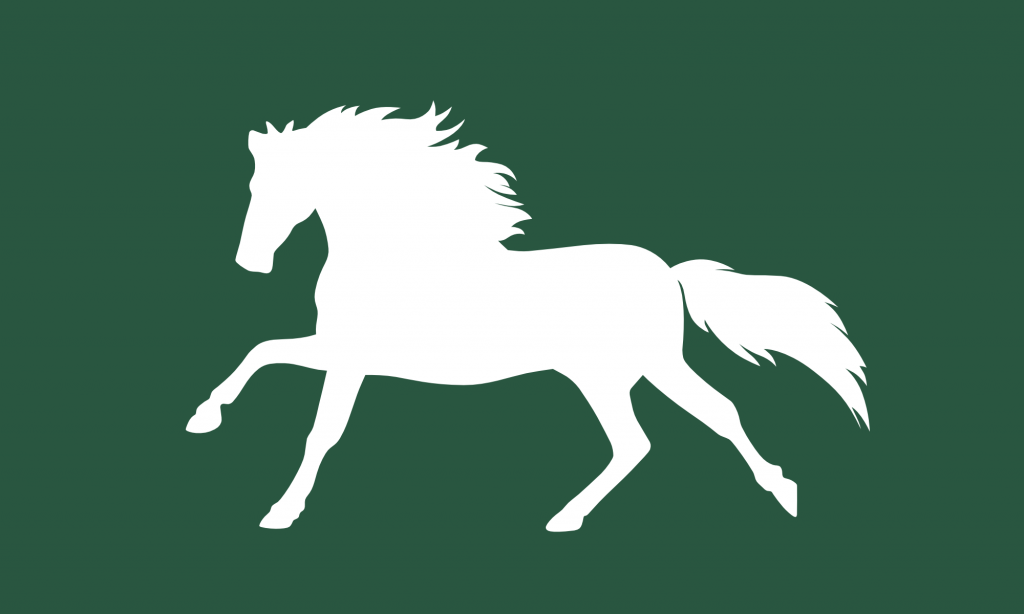
A Flag of Wiltshire – The White Horse Flag – Version 1

I found this very difficult to do. There were many choices to be made when making the design. What pose should the horse be in? How stylised should the design be? How detailed should it be? What colour green should I use?

I decided to have the horse running. Most of the hill figures show the horse standing, but I think that’s not quite dramatic or exciting enough for a flag. A horse running looks quite majestic.

Flag design – particularly flag design for English counties – is connected to, or even part of, heraldry. Heraldry has its own conventions and style. When drawing animals in heraldry (well, when drawing anything, really), there’s a certain style to how its drawn. It might have been nice to do that here, but I’m not sufficiently well versed in that style to be able to do it. In fact, I’m not sufficiently well versed in any style to be able to make a stylised illustration. So the design is very literal, and flat. There’s a danger that that can make something look a bit corporate (and looking corporate must be avoided at all costs), but I think the result is a simplicity that is easy to recognise, and easy to replicate. I have heard that a good flag design should be something that a child could draw from memory by hand.

Lots of flags nowadays – particularly country flags – have mathematical specifications for how they should look. It’s easy to see why countries do this – if the design is specified mathematically, there can be no arguments about whether any one copy of the flag is correct. Doing this is much easier with geometric designs, of course – it’s quite easy to do this with the Flag of England, the Flag of Scotland, the Union Jack, and countless others. But this kind of mathematical specification is somewhat at odds with traditional heraldry. In traditional heraldry, figures and shapes are defined descriptively, not mathematically, and colours are certainly not defined in a universal way. The design is allowed to vary. With the design above, any number of small changes could be made to the outline of the horse without it looking substantially different, so this kind of flag naturally resists mathematical definition. In some ways that’s a good thing – it puts the flag a bit more in line with traditional heraldry – but in some ways its a bad thing – it is hard (or impossible) to replicate the design exactly unless you have the original.

The horse figure on the flag is, of course, pure white. Choosing a green was difficult. When you really get into it, green is actually quite a difficult colour. There are so many different hues and shades of green, and they all carry with them their own connections, meanings, and moods. The exact green that I’ve chosen here has a hue of 150, a saturation of 35, and a lightness of 25. That makes it a bluish green (which I generally prefer myself, but which I think also has a very classic look to it). To me it is reminiscent of wet grass or foliage in autumn or winter. It is a deep, retreating green suitable for one of the most rural counties in the country.

While I like this design, I am not entirely convinced that it is what I intended when I set out on this project. Perhaps I would prefer something different? Perhaps there are slight refinements that I could have made, but which I overlooked? I can spend forever and a day contemplating designs like this and still not come to any conclusions about them. So rather than have this thing sit on my computer for years while I ponder it, I’m just going to label this one ‘Version 1’, and if I decide that actually I want to do something differently, I’ll come back later and do a version 2, version 3, and so on.

I do not intend for this flag to necessarily replace the existing official flag. I simply wanted to have the design, and allow other people to have it as well. How can we know what flag design we really want unless we have some options to choose between? I’m a huge fan of having unofficial versions of things that exist alongside the official versions – unofficial national anthems (like Rule, Britannia! and Land of Hope and Glory), unofficial national symbols – and in this case unofficial flags. We don’t just have to have one thing, the official thing.

So this is Version 1. I may come back later and make some different versions, but I think this version is simple, yet elegant, and majestic – distinctive, easily recognisable, and easy to like. I’ll get a few made for myself.

(Lots of information can be found on the existing official and unofficial flags here: https://britishcountyflags.com/2013/07/31/wiltshire-flag/ .)
Papyrocracy – Rule by Paperwork

Bureaucracy – Rule by Office – or, even more literally, Rule by Desk. A very useful word which in its mildest and most forgiving sense means a system of administration in which the administrators – officials – those of the office – follow rules very carefully, but which in its far more accurate, delicious sense means the tyranny of the official, and all of the inflexibilities, inefficiencies, incompetence, and general twattishness that inevitably follows.

And yet I find that this word is not enough to describe the kind of insanity that we are surrounded with in the present day. With every passing year, I notice that I have to give more and more scans of different documents to be able to do things – and the constraints on them have become narrower and narrower. ‘Send us a scan of a recent credit card statement or utility bill with your current address. It must be from the last 6 minutes, show your full name and star sign, and have been certified by a dental hygienist with a Ph.D. in Sanskrit.’ Completely ignoring the fact that everything’s gone paperless – I don’t know how I’m supposed to prove that I’ve ever lived anywhere now.

I have to give the same information out again and again to companies – and those most loathesome of all institutions, banks – even though they definitely have my name, telephone number, and address from the last time I gave it to them – which is invariably a few days ago. Somehow, their computer systems, perfectly capable of remembering my email address when they want to send me spam, suffer from attacks of amnesia at any other time.

I am actually shocked by how often I am asked to email someone a scan of my passport as proof of identity. How is this even allowed? Surely it’s a massive security failure to have everyone emailing scans of their passport all over the place all of the time? Why has what is supposed to be the most secure document you can own become equivalent to a meme?

We are ruled by little pieces of paper – as well as their electronic counterparts – and it’s mad’ning. I thought that perhaps rather than the word ‘bureaucracy’, we ought to have a word that literally means ‘Rule by Paper’. The word ‘paper’ is from Greek papyros – ideal – we can combine this in the usual way with the Greek-origin suffix -cracy, meaning ‘rule by’, for papyrocracy – Rule by Paper, Rule by Paperwork.

It turns out I’m not the first person to think of this word. The word already exists with this meaning – it’s just not a very common word at all. Some dictionaries list it as a synonym for ‘bureaucracy’, but I don’t think it should be thought of as a perfect synonym. I think ‘papyrocracy’ should refer to the absolute worst excesses of bureaucracy (itself already something that is the worst excesses) – when paperwork itself becomes the aim – when filling out forms again and again and again becomes the aim. In papyrocracy, you are a slave to little pieces of paper – nothing happens without them, yet having them in no way ensures that the right thing happens – just that what happens conforms to what the little pieces of paper say. The purpose of everything becomes filling out forms – to no real end other than to fill out more forms. In the style of Douglas Adams, one might call it ‘Vogocracy’. In the style of Matt Lucas and David Walliams, it’s the final, all-consuming tyranny of ‘Computer says no.’.

Words of Creation – Words that end with the Greek suffix ‘-poeia’

A few weeks ago, I came across the word ‘mythopoeic’. What a nice-looking word! Dictionaries give its meaning as ‘pertaining to the creation of myths’, but I sense it has a true meaning that is a bit subtler than that.

It comes from Greek mythos – obviously – meaning ‘myth’, ‘story’, ‘thought’, ‘discourse’, and Greek poiein, meaning ‘to create’ – from which we also get the word ‘poet’. Who’d’ve thought – the word ‘poet’ literally just means ‘one who creates’. (I guess that means we’re all poets now. Oh dear.)

From ‘mythopoeic’ we can get to ‘mythopoeia’, which is ‘the creation of myths’. It didn’t occur to me, at first, that there were other words ending with ‘-poeia’, but there are, and these form an etymological family of words all pertaining to creation.

As always with this series of posts, first I will list words ending with this suffix that I’ve found in dictionaries. (It may not be an exhaustive list.)

WordMeaning
pharmacopoeia‘the making of medicine’
logopoeiaThe creation of words – not in the sense of coining new words, but in the sense that a word is formed over time by its usage in different contexts, and the associations it gains through its usages. (This word may be worth a blog post of its own.)
phanopoeiaThe creation of images – particularly within the mind, the visual imagination.
melopoeiaThe creation of sounds – again particularly in the sense of writing that builds the idea of a sound in the mind.
prosopopoeiaThe putting of words into the mouths of others – what a great word. (A complex etymology.)
onomatopoeiaThe famous one – ‘the formation of words or names by imitation of natural sounds’.

Most of these ‘-poeia’ words are quite grand, so perhaps any new words made with the ending should be similarly grand. Below I’ve thrown together some new words that could be made with this ending, but they’re a bit literal.

WordMeaningAdjectival Form
geopoeia‘the creation of the Earth’geopoeic
rhabdopoeia‘the creation of wands / staffs’ – a great one for fantasy – a person who creates wands or staffs (like Ollivander) could be a ‘rhabdopoet’ – particularly in reference to the magical, rather than mechanical, aspects of creating a wandrhabdopoeic
astropoeia‘the creation of stars’ – for extra grandeur of concept, this could be used for metaphorical stars – i.e., celebrities – ‘the process by which a person becomes a celebrity and the crafting of their public image’ (although perhaps this rather removes grandeur than adds it)astropoeic
oneiropoeia‘the creation of dreams’ – again, could be used for literal dreams, or this word could be used to refer to how aspirations are instilled in the people of a given society – i.e., the process by which the American Dream is instilledoneiropoeic
arithmopoeia‘the creation of numbers’ – could be used to refer to the process by which mathematicians deduce that a different class of number (such as imaginary and complex numbers) is neededarithmopoeic
chronopoeia‘the creation of time’ – could be used to refer to how different events and activities create the perception of time in the mind – i.e., a very boring activity that makes time go slow is chronopoeicchronopoeic
sophopoeia‘the creation of wisdom’ – could be used to refer to the methods and environments that create wisdom within those going through educationsophopoeic
alethopoeia‘the creation of truth’ – could be used to refer to how governmental and media institutions try to ‘create’ a ‘truth’ that may well be different from actual, objective truth (although perhaps this is a rather grim usage of such a grand word)alethopoeic

No, the comma does *not* always go before the closing quote mark – Logical Punctuation

‘The comma always goes before the closing quote mark.’

I’ve heard this a number of times over the last 7 years or so – mostly, but certainly not exclusively, from Americans.

And I had heard it in life before that too. I can’t remember exactly when I first heard it – I think it was possibly in secondary school, from one of my secondary school English teachers. But I do remember that when I first heard it, I immediately thought ‘That’s silly.’.

Consider the following sentence.

‘I think I like pears more than I like apples.’

Now let’s imagine that this is a line said by someone – a character in a novel, perhaps. Now, the ‘he said’ / ‘she said’ could be put at the end.

‘”I think I like pears more than I like apples.”, she said.’

Or we could split the sentence and put the ‘he said’ / ‘she said’ in the middle.

‘”I think”, she said, “I like pears more than I like apples.”‘

This illustrates the problem. That first comma in the line above – those who say ‘The comma always goes before the closing quote mark.’ would have it go before the first closing double quote mark – immediately after the word ‘think’.

But I think this is ridiculous. That comma is not part of the original sentence – what this person is actually saying. It is not part of the ‘inner sentence’ – it is part of the ‘outer sentence’. For clarity, I’ve written the same text again below, but coloured the ‘inner sentence’ green and the ‘outer sentence’ blue.

‘”I think, she said, I like pears more than I like apples.“‘

The double quote marks are the demarcations between the inner and outer sentences. You can join together all of the separately-quoted parts of the inner sentence to get back the original thing being quoted.

If we were to follow the ‘The comma always goes before the closing quote mark.’ rule, however, we would have:

‘”I think, she said, I like pears more than I like apples.“‘

This is clearly less elegant. The inner and outer sentence are now mixed together across the quote marks.

So I would say that the correct rule is: only that which is part of the quote goes within the quote marks.

Now sure, commas are for adding structure to written language – we do not speak them. (Well, they sort-of represent pauses in spoken language, but it’s not a hard-and-fast rule, and they’re better understood as making clauses easier to recognise in written text.) But that structure is still either of the inner sentence or the outer sentence, and putting a comma in the inner sentence when it’s actually part of the outer sentence can change the meaning.

I learned a while ago that my preferred style of using punctuation is called logical punctuation. And apparently the other style – the comma-before-the-quote-mark style – is known as typographer’s punctuation, or something like that. I’m not too sure about these names. ‘Logical punctuation’ is a bit grandiose, even if it is more logical, and I don’t know why typographers would be expected to be so slapdash in their approach to punctuation. But apparently these are terms that are used.

I’ve also seen it said that logical punctuation is the British style, and the other way is the American style. I’ve certainly heard Americans advocate for the comma-before-the-quote-marks style more often. I’ve heard Britons insist upon it too, though whether this is just because of the cultural backwash we get from America, I can’t say.

But regardless of what the best names for these styles are, and regardless of whether the Britons or the Americans use one style more, it is better to use logical punctuation.

The main argument I hear in favour of the American style is ‘It looks better.’. There’s just something about the lower punctuation mark followed by the higher one that looks better than the inverse. While aesthetics are very important in language, to some extent (only some) what you like is just what you get used to over time, and aesthetics should generally not be at the expense of function and semantics. (There are exceptions, of course, but generally.)

Some would say that my approach is perhaps the product of a mathematical mind. (I am a physicist by training.) You can certainly see the appeal of logical punctuation to a mathematical mind – logical punctuation perfectly mimics the way brackets work in mathematics. However, this is somewhere where the penetrating orderliness of mathematics should influence human language. Using logical punctuation allows you to avoid a great many problems that arise if you try to use the American style. The American style generally applies not just to commas, but to all punctuation. Consider the following sentence.

‘What did he say after “You’re not supposed to do that?”‘

The typographer’s style advocates for putting that question mark before the closing double quote mark, as I’ve written it above. But is the question mark part of the inner sentence or the outer sentence? Or both? You can’t tell – but it changes the meaning. If the question mark is part of the inner sentence, the person being quoted is asking a question. If it’s not part of the inner sentence, the person being quoted is making a statement.

This is clearly a problem, and if you try to follow the American style for an entire book, you will run into variations of this problem over and over again – with no way to be both consistent and always unambiguous. (You might think the problem won’t come up very often, but it does – it comes up A LOT.)

Logical punctuation solves this easily. If the inner sentence is a statement, you write:

‘What did he say after “You’re not supposed to do that.”?’

and if it’s a question, you write:

‘What did he say after “You’re not supposed to do that?”?’

Some people might find it visually clumsy to have all those punctuation marks bundled together like that. But again, the aesthetics you can adjust to if you just get used to it – but the semantic issues of the typographer’s style cannot be cleanly resolved.

I hope that logical punctuation becomes more popular. Britons seem to be split on it. But I think it’s an easy rule to remember: only that which is part of the quote goes in the quote marks.

A dictionary of vocables

Vocables are fun. Vocables are those words that aren’t quite words like ‘ah’ and ‘oi’ and ‘huh’. They’re normally an approximation of a sound we make in conversation to convey a specific idea.

To me, every vocable has a very specific meaning, and I choose which vocable I use at a specific point in a piece of text very precisely.

So I thought I’d write down what I think lots of different vocables mean in a kind of short dictionary of vocables.

Ow, Argh – Pain
Aw – Adoration
D’aw, D’aww – Excessive Adoration
Ew, Eww – Disgust
Oh – Realisation
Ooh – Titilating Realisation
Ah – Exciting Realisation, Disappointment, Awkward Realisation
Ahh – Nostalgia
Aah – Relaxation
Uh, Um, Er, Erm – Hesitation
Om, Ohm – Meditation
Aha – Surprise
Ha – Cynical Laughter
Hahaha – Continuous Laughter
Bhahaha, Phahaha – Explosive Laughter
Haha – Are you an idiot? No-one laughs like that.
Mhm, Mha, Mwahaha – Evil Laughter
Heh heh, Hehe – Aspiring Evil Laughter
Teehee – Mischievous Laughter
Oi!, Hey! – Critical Interjection
Ey, Eh – Knowing Suggestion
Meh, Eh – Indifference, Apathy
Psst – Whispered Interjection
Pfft – Cynical Rejection
Hmm – Thought
Mmm – Deliciousness
Huh – Confusion
Arr! – Pirates
Zzz – Sleep