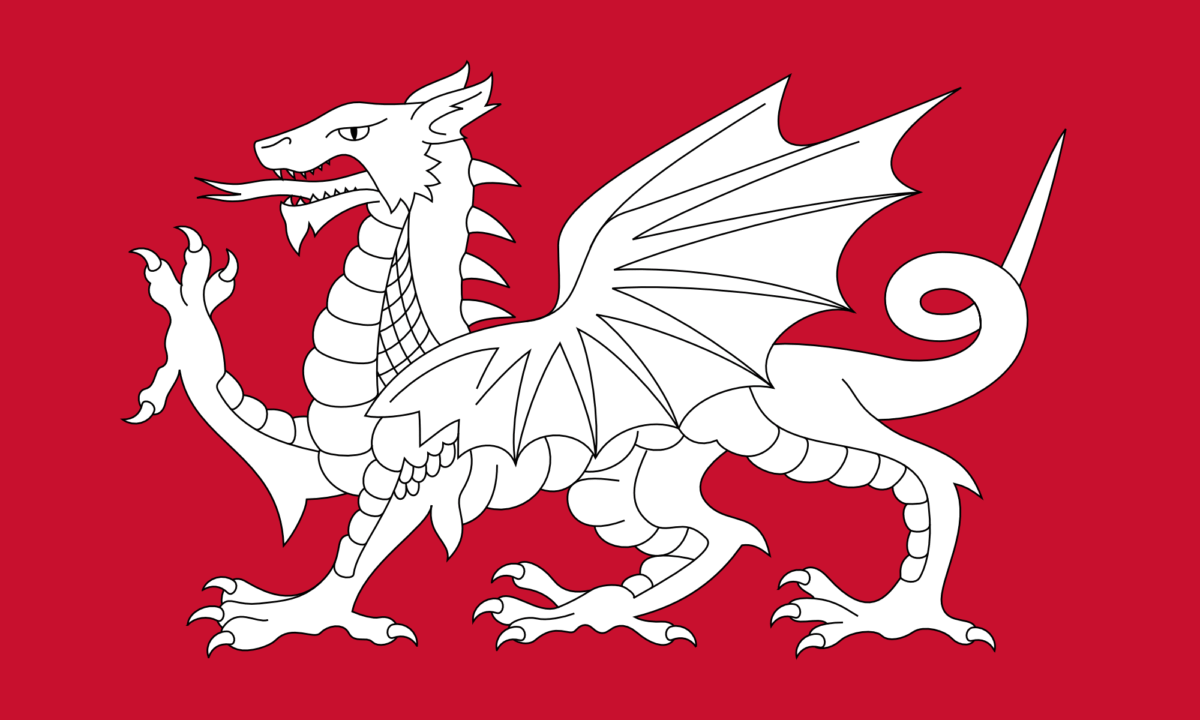
A Flag of the English – The White Dragon Flag

I have always been tremendously jealous of the Welsh flag. It’s got a dragon on it – it looks fantastic.

The English flag, by comparison, is rather plain – a red cross on white. Plainness is generally quite a good thing in flag design – it means the flag is easily recognisable and easily reproducible. But still – who doesn’t want a dragon? Dragon flags look fantastic. The flag of Bhutan has a dragon on it, and it looks amazing. The flag of the Qing dynasty also had a dragon on it, and that looks even better – a truly outstanding flag design – much better than the current Chinese flag – they should consider going back to it.

Why can’t we have a dragon on our flag? Well the thing is … we could. The symbolism of the red dragon on the Welsh flag goes back to Arthurian legend. A red dragon and a white dragon are locked in combat, with the red dragon representing the native Britons (the Celts) – now the Welsh – and the white dragon representing the Anglo-Saxons – now the English. So a white dragon is a symbol of the English.

This is fairly well known – lots of people already know this, and lots of people have already had the idea of making a white dragon flag to represent the English. (I mean, you could argue the idea never went away from Anglo-Saxon times – the Kingdom of Wessex used a golden dragon as its symbol (still on the flag of Wessex today, though as a wyvern (the distinction being somewhat unimportant here)), and the flag of Somerset also features a dragon.) But the idea has not spread very far – partly I think just because of a lack of awareness of the symbol, but also because of a lack of good designs. A good design propagates on its own.

So for a while now I’ve thought it would be good to make some designs for an English White Dragon flag – an unofficial flag as an alternative to the St. George’s Cross.

The simplest thing to do is just to change the colours on the Welsh flag, as shown below. (I am most certainly not the first person to do this – you can see that others have already done it just with a quick internet search.)
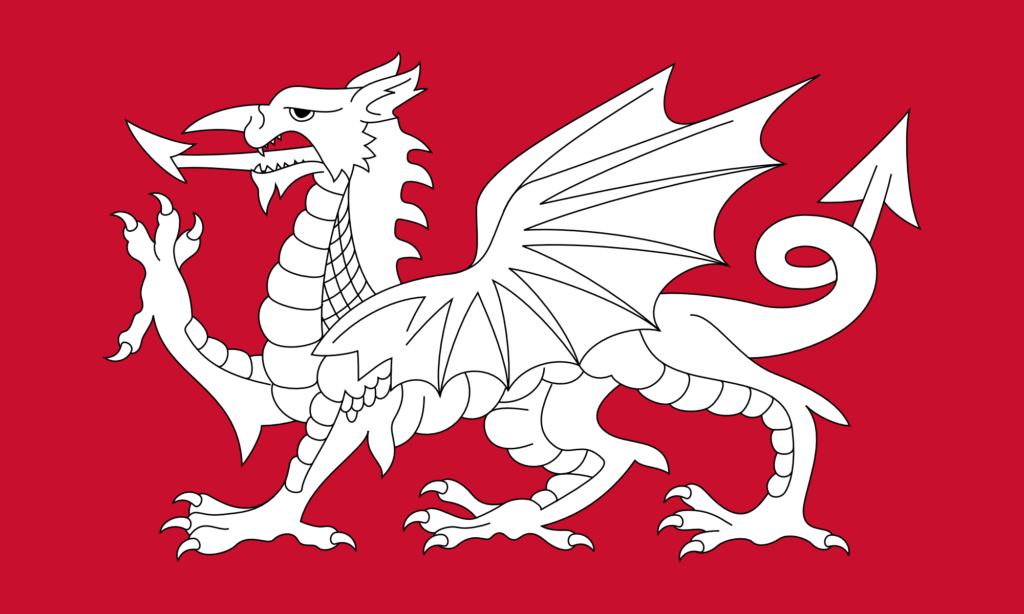
This is the exact same design as the Welsh flag – it just uses the red of the dragon from the Welsh flag as the background, and then the dragon itself is pure white. The design is incredibly striking – I think actually even more so than the Welsh flag.

This design also looks fantastic with a black background.

As with my design for a flag of Wiltshire (featuring a white horse), I find myself torn between different styles of illustration. The dragon on the Welsh flag is obviously very stylised – it’s not just a dragon, it’s a heraldic dragon. I particularly like heraldry and I quite like the heraldic style of illustration, but I do think there are some things that are a bit odd about the design here.

I have never liked what I call the ‘demon’s tail’ style of tail that the design above has. Almost every cartoon drawing of a demon has a tail like that. Personally I think it would look better if it were more naturalistic. That goes for the dragon’s tongue too.

I have also never liked the ‘nose horn’ of the dragon. This seems like a rather odd place to have a horn (that is, a forward-pointing one). In more naturalistic depictions of dragons – which are rather common nowadays thanks to CGI – you never see this. (It’s a remarkable thing that, with decades of stories and movies about dragons, we now have a very strong collective understanding of what a dragon is supposed to look like.)

So I set about modifying the above design. The result is below.
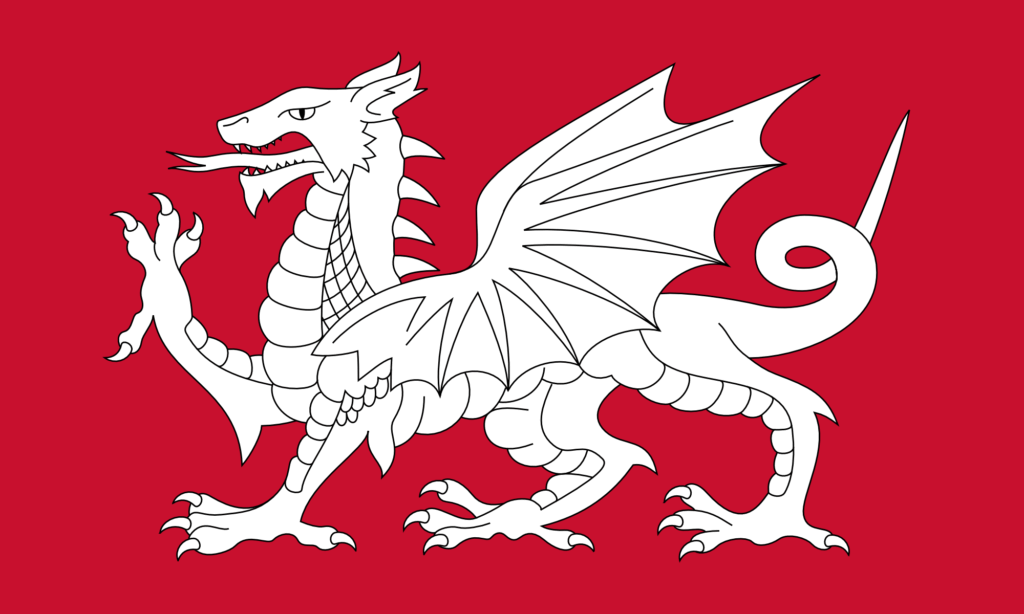
As with my design for a white horse flag for Wiltshire, I found that there were so many things to agonise over while making this design.

I wanted to make some improvements to the design, but I also wanted to retain much of the style – the heraldic style – of the original design. Of course, here we’re not dealing with a purely mathematical design – we’re dealing with freeform paths that can be given any shape. Should this control point go here? Should I move it slightly? Is that a better curve? That looks good, but does it deviate from the style too much? I agonised for hours and hours over it. I am not really certain about most of it, but at some point you just have to decide that it’s done.

I have removed the ‘demon’s tail’. I have also changed the tongue. Now, I’ve given it a forked tongue – that’s sort of a bit of a problem because of course a forked tongue typically carries the symbolism of the snake and of deception. That’s not the intended meaning here, of course – the aim is just to be naturalistic.

I have removed the nose horn, and elongated the dragon’s face. I think this is a tremendous improvement – again, more naturalistic – but of course it does lose some of that heraldic style. I have changed the eye quite substantially – making it a bit meaner. The eye on the original design makes the dragon look a bit dopey. I have also adjusted its spines – and I think this is the only change that I’m completely sure of.

There are so many other things I could have changed (adding more spines along the tail, changing the wings to be a bit more anatomical, changing the ears to look a bit more reptilian, and so on), but of course that risks losing some of the style. As with my white horse flag for Wiltshire, I consider this to just be Version 1 – I may make other versions in future with more modifications. I would also like to make some versions that don’t use the heraldic design at all – and which use something a bit more ‘modern’, for lack of a better word.

So we English can have a dragon on our flag, and it looks rather good. As ever, I don’t suggest making this the official flag – it’s just nice to have as an unofficial one. I’ll be getting some of these made for myself.
A Flag of Wiltshire – A White Horse on a Green Field

I was born in Wiltshire, and I have lived in the county for the majority of my life. I have a very long ancestry here – I can trace my ancestry back over 400 years in just one town. (And it certainly goes back further than that – 400 years is just what I’ve been able to trace.) Various branches of the family tree spread out across the county.

There is, if you didn’t know, an official flag of Wiltshire. All (or at least most – I haven’t checked) of the English counties have flags. The Wiltshire one was designed in the 2000s by Mike Prior. I’m not overly enthusiastic about the design: curved green and white stripes, with a green circle in the middle and a golden great bustard (a bird native to Wiltshire) on top. (I like the great bustard, but I just don’t quite like the shapes in the rest of it.)

I’ve known for a while that there has been an alternate flag design – an unofficial one. It features a white horse on a field of green. It is a reference to the many white horse figures that can be seen on hillsides throughout the county – Wiltshire has the most white horses of any county. This seems like a much more fitting symbol of the county than stripes and the great bustard. (Of course, Wiltshire doesn’t have the Uffington White Horse figure – the original, prehistoric white horse figure, which is about 2000-3000 years old. That’s in Oxfordshire, in the Vale of the White Horse. But that hill figure is less than 10 miles away from the border of Wiltshire – the Vale of the White Horse itself bordering Wiltshire, of course.)

This unofficial white horse flag was apparently also designed in the 2000s, by Chris Fear. While I like the idea of a flag of Wiltshire featuring a white horse, I’m not too enthusiastic about this specific design either. It’s based on the Cherhill White Horse – which is a white horse hill figure that’s located in the county. But that hill figure looks a little peculiar – in fact it almost looks more like a deer than a horse. Symbolism is extremely important (in flags, but also in anything artistic), but I think a bit of creative licence is also valuable in order to make a design that’s really distinctive (and, with luck, iconic).

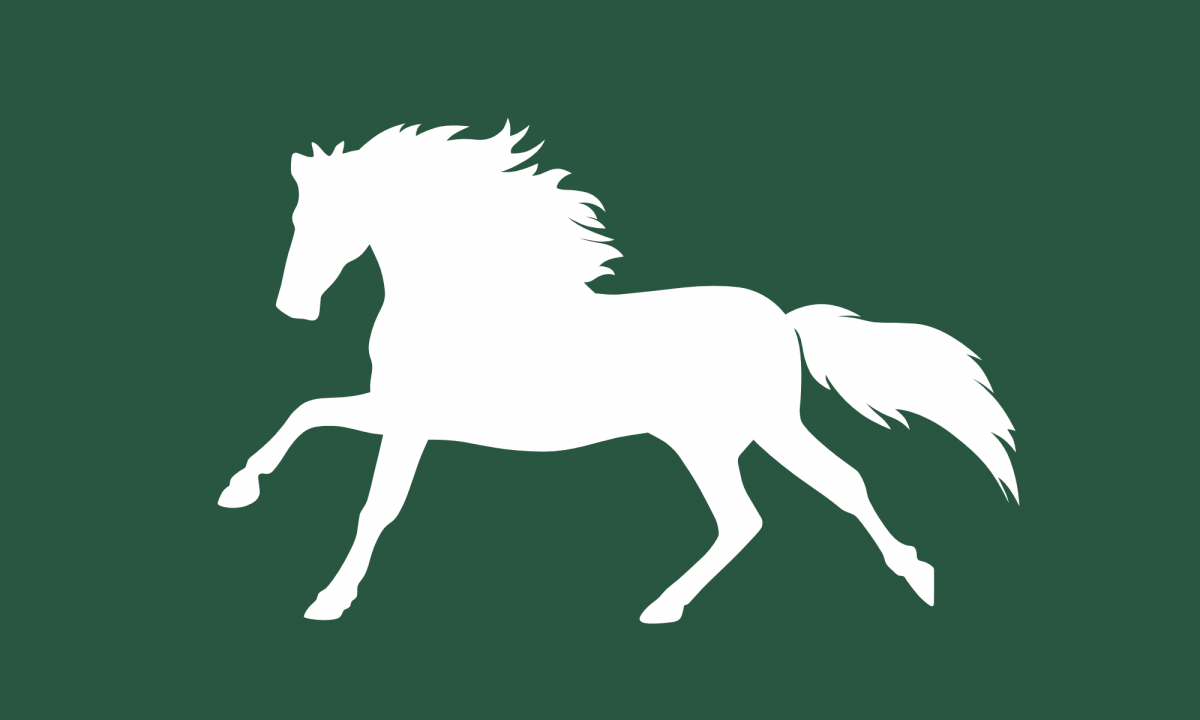
So recently I’ve been thinking: why not make a new design? A new design of a white horse on a green field, but one which is a bit more … horsey – and, dare I say, dramatic … expressive …

It’s taken me a while to get round to doing it, but now I’ve done it, and the design is below.

A Flag of Wiltshire – The White Horse Flag – Version 1

I found this very difficult to do. There were many choices to be made when making the design. What pose should the horse be in? How stylised should the design be? How detailed should it be? What colour green should I use?

I decided to have the horse running. Most of the hill figures show the horse standing, but I think that’s not quite dramatic or exciting enough for a flag. A horse running looks quite majestic.

Flag design – particularly flag design for English counties – is connected to, or even part of, heraldry. Heraldry has its own conventions and style. When drawing animals in heraldry (well, when drawing anything, really), there’s a certain style to how its drawn. It might have been nice to do that here, but I’m not sufficiently well versed in that style to be able to do it. In fact, I’m not sufficiently well versed in any style to be able to make a stylised illustration. So the design is very literal, and flat. There’s a danger that that can make something look a bit corporate (and looking corporate must be avoided at all costs), but I think the result is a simplicity that is easy to recognise, and easy to replicate. I have heard that a good flag design should be something that a child could draw from memory by hand.

Lots of flags nowadays – particularly country flags – have mathematical specifications for how they should look. It’s easy to see why countries do this – if the design is specified mathematically, there can be no arguments about whether any one copy of the flag is correct. Doing this is much easier with geometric designs, of course – it’s quite easy to do this with the Flag of England, the Flag of Scotland, the Union Jack, and countless others. But this kind of mathematical specification is somewhat at odds with traditional heraldry. In traditional heraldry, figures and shapes are defined descriptively, not mathematically, and colours are certainly not defined in a universal way. The design is allowed to vary. With the design above, any number of small changes could be made to the outline of the horse without it looking substantially different, so this kind of flag naturally resists mathematical definition. In some ways that’s a good thing – it puts the flag a bit more in line with traditional heraldry – but in some ways its a bad thing – it is hard (or impossible) to replicate the design exactly unless you have the original.

The horse figure on the flag is, of course, pure white. Choosing a green was difficult. When you really get into it, green is actually quite a difficult colour. There are so many different hues and shades of green, and they all carry with them their own connections, meanings, and moods. The exact green that I’ve chosen here has a hue of 150, a saturation of 35, and a lightness of 25. That makes it a bluish green (which I generally prefer myself, but which I think also has a very classic look to it). To me it is reminiscent of wet grass or foliage in autumn or winter. It is a deep, retreating green suitable for one of the most rural counties in the country.

While I like this design, I am not entirely convinced that it is what I intended when I set out on this project. Perhaps I would prefer something different? Perhaps there are slight refinements that I could have made, but which I overlooked? I can spend forever and a day contemplating designs like this and still not come to any conclusions about them. So rather than have this thing sit on my computer for years while I ponder it, I’m just going to label this one ‘Version 1’, and if I decide that actually I want to do something differently, I’ll come back later and do a version 2, version 3, and so on.

I do not intend for this flag to necessarily replace the existing official flag. I simply wanted to have the design, and allow other people to have it as well. How can we know what flag design we really want unless we have some options to choose between? I’m a huge fan of having unofficial versions of things that exist alongside the official versions – unofficial national anthems (like Rule, Britannia! and Land of Hope and Glory), unofficial national symbols – and in this case unofficial flags. We don’t just have to have one thing, the official thing.

So this is Version 1. I may come back later and make some different versions, but I think this version is simple, yet elegant, and majestic – distinctive, easily recognisable, and easy to like. I’ll get a few made for myself.

(Lots of information can be found on the existing official and unofficial flags here: https://britishcountyflags.com/2013/07/31/wiltshire-flag/ .)

The Book of the Order of Chivalry – One of the greatest books I have ever read

Almost every week nowadays, I marvel at the things not taught to me when I was in the education system.

It’s a common refrain – ‘Why aren’t they teaching this?’, ‘Why aren’t they teaching that?’ – but I mean it in an even deeper sense. It’s not just that there are certain things that are not taught – they’re not even mentioned. An example of this is Anglo-Saxon history. I was taught nothing about Anglo-Saxon history when I was in school. This is astonishing given that the Anglo-Saxons were the start of the English – all of the history of the British Isles before that is British history but not English history. But even more than that, in the entire five years I spent at secondary school, I don’t think the term ‘Anglo-Saxon’ was mentioned even once.

There are also many examples of things not being taught or even mentioned from my university education. I could write hundreds of blog posts (not an exaggeration) about how low quality my university education was – there’s no point trying to cover it all here. But in addition to many utterly bizarre choices in course structure, there were hundreds of important things that were never even mentioned. In physics we were not taught the conceptual framework around waves properly to understand radiation pressure or the derivation of the black-body spectrum curve; we were not taught Minkowski diagrams properly; we weren’t taught measurement and uncertainty properly. In mathematics we were not taught matrices properly, or the principles of limits. We didn’t even really do complex numbers properly, though we did do a lot with them. The way we were taught quantum mechanics was utterly abysmal. And we were taught absolutely nothing about the history of physics.

I could go on and on and on, but that’s not what this post is about. It is in the time since leaving the education system that I have learned about these things. Everything I know about Anglo-Saxon history – which, of course, went into the writing of On The Subject Of Trolls – I have learned myself.

If you have grown up in Britain around the same time as me (I am a millennial), you will have heard the word ‘chivalry’ thrown around from time to time. You of course know that it has something to do with mediæval knights – it was some sort of practice that they had or ideal that they strove towards. You will have heard the word ‘chivalry’ used to refer to certain kinds of behaviour in the modern age – usually things as drab as holding doors open for people. You will also have heard the word used by feminists. Over the last 30 years, they have typically used it in a derogatory sense, referring to actions or behaviours that they consider to be outdated and offensive to their belief system.

All of this – everything that has been said of ‘chivalry’ in popular culture in the last 30 years (at least) is wrong. Not only is it wrong, it is completely wrong. It doesn’t even get the basic ideas of what actual chivalry is right.

I have recently been reading a book on heraldry. This book makes reference to other works as it goes along, and at one point – quite early on – it describes a book called The Book of the Order of Chivalry. This book was written in the 1200s, and it describes exactly what chivalry was supposed to be, and what knights were supposed to do. I had no idea that there even was such a book. What’s more, The Book of the Order of Chivalry was apparently considered to be the standard text describing what chivalry was for a very long time. What an extraordinary thing – that there is a definitive text telling those who aspire to be knights what a knight was and what chivalry was!

When I saw this a few weeks ago, I was already complaining in my head of how this wasn’t ever mentioned to me while I was in the education system. I looked around online to see if I could read it – for old texts, very often you can read a scan of them somewhere online. I went onto Amazon to see if I could buy a modern copy of the book – and I could – there was a modern translation of the book available. (Not so modern as to be affected by the rot that is currently creeping through academia.) I bought it.

The Book of the Order of Chivalry is not a long book – in the translation that I have, it doesn’t even pass fifty pages. But when I was reading through it, it was nothing short of enlightening. And I don’t mean that in an exaggerative sense – reading it was as though the light of knowledge was shining into my mind.

Chivalry is an entire system for producing persons of good character – persons who are well trained in the various martial arts of a knight, and so are very physically capable, but who are also learned, and so very mentally capable. It is a system that, through the production of such persons, produces a good and orderly society. It also contains methods of self-regulation – necessary for when someone comes along who tries to subvert the system.

Although The Book of the Order of Chivalry was written in the 1200s and is specifically about knights, and those who wish to become them, many of the prescriptions it gives about how knights should be could apply to anyone, in any time period, who wants to be a good person or build a good society. That’s one of the things that was so fantastic about it – huge parts of it are completely relevant to life today. Some of it appears to be astonishingly prescient – there are problems that exist in the world today that this book has the solution to. And this is what makes it downright outrageous that this book has seemingly been hidden from us in the modern age – the solutions to many problems that exist today – sometimes very specific problems – have been known for centuries.

Take the following paragraph from the translation by Noel Fallows:

The king or prince who unmakes the Order of Chivalry itself not only unmakes himself as a knight, but also the knights who are subordinate to him who, because of the bad example set by their lord and so that they will be loved by him and follow his evil ways, do what does not pertain to Chivalry or its Order.

Ramon Llull, The Book of the Order of Chivalry

In other words, if any knight acts in a way that is not in accordance with true Chivalry, he not only unmakes himself as a knight, but also all of the knights he trains or is in command of.

This is a principle that is relevant not only to Chivalry, but to any organisational structure, in any time period.

Take another paragraph:

If the squire should be dubbed a knight because of fineness of features or a well-built, well-proportioned body, or because he has fair hair or carries a mirror in his purse […] you debase and diminish the Order of Chivalry.

Ramon Llull, The Book of the Order of Chivalry

What an amazing thing to read! Don’t just reward people with status and power because they are good-looking – it’s a principle that can apply to every society in every time period.

Take another one:

The prideful, ill-mannered squire who speaks and dresses crudely, has a cruel heart, is avaricious, mendacious, disloyal, slothful, irascible, lustful, drunken, gluttonous or perjurious, or who has other vices similar to these, is not suited to the Order of Chivalry.

Ramon Llull, The Book of the Order of Chivalry

To how many people does this apply today! Every week there seem to be more and more people who could be described in this way. And not only are they not suited to the Order of Chivalry, they are not suited to any position where they have any influence – particularly positions of cultural influence, which they seem to currently occupy.

Here’s another:

Do not seek nobility of courage in the mouth, for it does not always tell the truth, and do not seek it in resplendent vestments, for beneath many a resplendent cloak there is a base and weak heart filled with evil and deceit.

Ramon Llull, The Book of the Order of Chivalry

I would like to give more quotes from the book, but I fear I could very easily pass the threshold of fair use. This book is filled with good advice on how to be, how to act, how to live, how to learn, how to teach, how to train, who to trust, who to grant status, how society should be.

Chivalry – true Chivalry – is not just a few trite mannerisms – it is not just a set of pedantic rules for small actions. It is an entire way of life – and one designed to improve society. It is a tragedy that we have forgotten what it is.

It’s worth mentioning that Llull is adamant that you cannot be a knight unless you are a Christian – nothing truly chivalrous can follow without that. I am a staunch atheist. In the era of New Atheism, I was a more combative one (which was of course a big part of what New Atheism was), but nowadays I am not, and I find those who retain that combativeness towards Christianity to be rather cliché and tiresome now – it’s not needed anymore. So I can appreciate the value of the ideas in this book without being a Christian. At the same time, it’s interesting how Llull often writes about the importance of using reason and scientific knowledge (‘scientific’ perhaps not quite in the modern sense), and of avoiding superstition. Such ideas would have been very pleasing to the New Atheists of 2007-2012.

It is outrageous that modern popular culture – and modern feminism – lies to us about what true Chivalry is. It is outrageous that the modern education system does not tell us what it is. It is outrageous that the modern education system doesn’t even tell us about the existence of this book. And it is outrageous that wisdom that has been around for centuries is hidden from us – wisdom that we could use today.

Reading this book was enlightening – not because I didn’t know or believe many of the ideas that are in it – a lot of them are actually ones I already knew and agreed with – it was enlightening because I was realising just how long this knowledge has existed for. It was there. It was always there.

It was also remarkable just how much the ideas overlapped with ideas from another part of my life: Taekwondo. I have done Taekwondo for more than 20 years – it’s been a huge part of my life. Taekwondo has a moral dimension. What was amazing reading this book was how mediæval Chivalry (from Europe eight hundred years ago) and Taekwondo (which developed in Korea in the last century) have produced many of the same ideas. Two completely unconnected cultures produced the same ideas. Extraordinary.

True Chivalry is, in many ways, the antidote to the poison that is modernity. It is the balm that could heal many today. It is not something to be contemptuous towards – it is quite possibly the very thing that we, the English, need at this moment in time.

I have not shown you the very best part of the book – that should be saved for when you read it yourself. And I think you should read it yourself. There are very few books that I would say that everyone should read, but this is one of them. Every Englishman should read this book.

You can get the version I read here: https://amzn.to/3HDxmmT (affiliate link).


P.S. While I have tried to be very clear here as to the reasons why I like this book so much, in time the reasons will become clearer still.